How the chart works
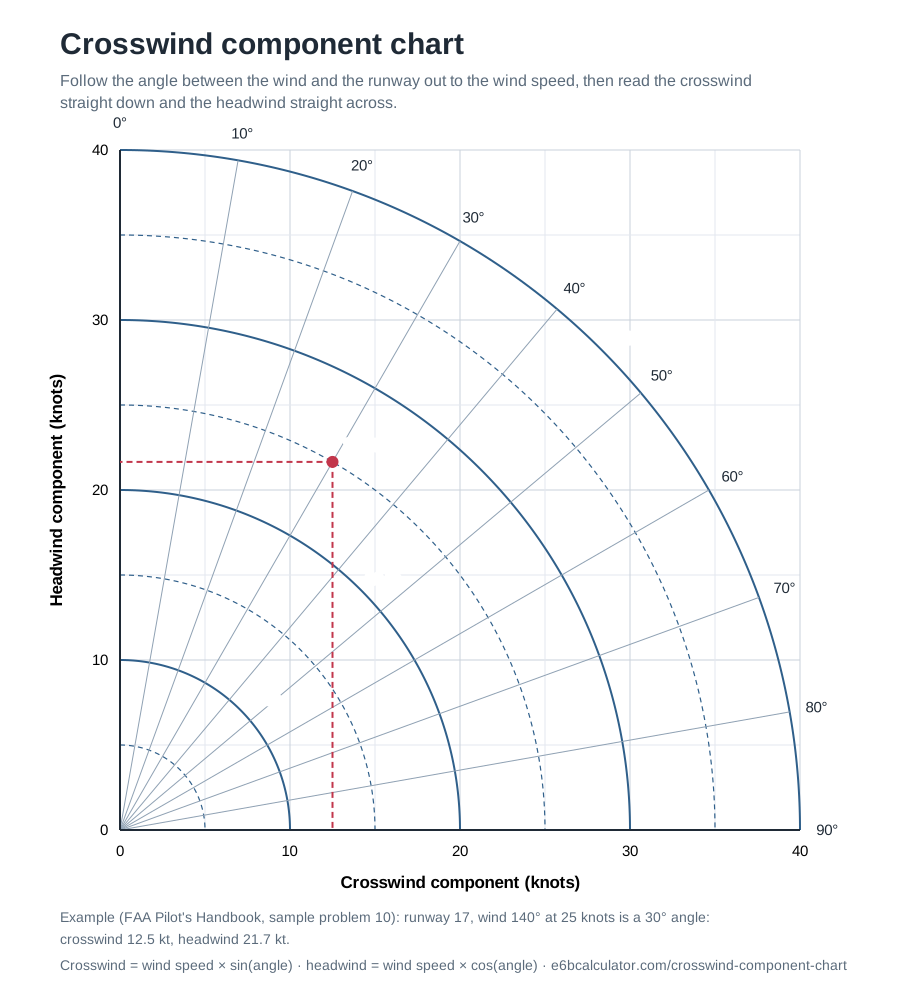
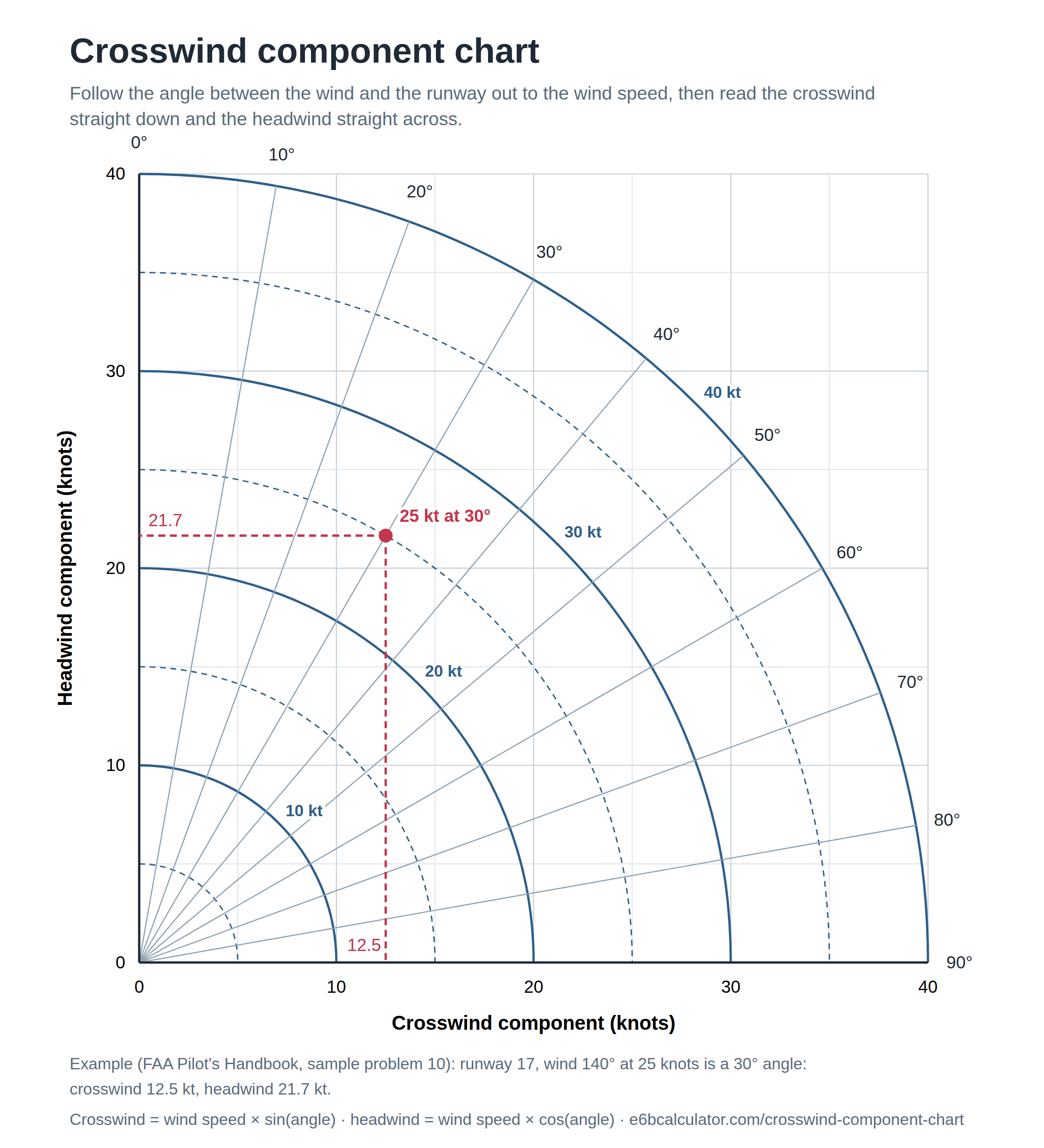
Any wind that is not straight down the runway splits into two parts: the crosswind component pushes the airplane sideways, and the headwind component slows it along the runway. The chart draws both at once. Each arc is a wind speed, each straight line an angle between the wind and the runway, and where the two meet you read the crosswind along the bottom and the headwind up the side.
The worked example is the FAA Pilot's Handbook of Aeronautical Knowledge's sample problem: runway 17 with the wind from 140° at 25 knots. Runway 17 is 170°, so the wind is 30° off the runway; the 30° line meets the 25-knot arc above a crosswind of 12.5 knots and beside a headwind of 21.7 knots. The crosswind calculator does the same arithmetic from a runway number and a METAR wind, adds the gust component and checks it against your limit.
Reading it quickly
- The angle is the difference between the runway heading and the wind direction, whichever side the wind is on. Runway numbers are magnetic; METAR winds are true, ATIS and tower winds magnetic. Convert a METAR wind before you compare.
- Beyond 90°, the wind is behind you. Use 180° minus the angle: the crosswind reads the same and the headwind becomes a tailwind.
- Gusts: read the chart again at the gust speed. The steady wind is what you hold most of the time; the gust is the worst case.
- Shortcut for the table below: the headwind at any angle equals the crosswind at 90° minus that angle, so one table gives both.
Rules of thumb
Pilots often estimate the crosswind with the clock method: at 15° off the runway the crosswind is about a quarter of the wind, at 30° about half, at 45° about three quarters, and from 60° on almost all of it. The chart shows why: the sine of 30° is exactly one half, and the sine of 60° is already 0.87.
Your crosswind limit
The Pilot's Handbook explains that airplanes are tested before certification in 90° crosswinds of up to 0.2 VS0, two tenths of the power-off stalling speed with gear and flaps down: an airplane that stalls at 45 knots must be capable of landing in a 9-knot, 90° crosswind. The maximum demonstrated crosswind component for your airplane is in its AFM or POH. Compare the chart's crosswind, and the gust value, with that number and with your own experience before you commit to the runway.
Print it
The chart is a white sheet that prints on letter or A4 paper: download the PDF for a kneeboard or a lesson, the SVG to scale it without blurring, or the PNG for slides. Every line is drawn from the same formulas as the calculators on this site.
How to read the crosswind component chart
- Find the angle between the wind and the runway: runway 17 is 170°, so a wind from 140° is 30° off the runway.
- Follow the 30° line out from the corner of the chart until it meets the arc for the wind speed, 25 knots.
- From that point, read straight down to the crosswind component, 12.5 knots, and straight across to the headwind component, 21.7 knots.
Questions pilots ask
How do you read a crosswind component chart?
Work out the angle between the wind direction and the runway heading, follow that angle line to the arc for the wind speed, then read down for the crosswind and across for the headwind. With the wind 30° off the runway at 25 knots, the crosswind is 12.5 knots and the headwind 21.7 knots.
What is the formula behind the chart?
Crosswind = wind speed × sin(angle) and headwind = wind speed × cos(angle). The chart is the same calculation drawn as arcs for the wind speed and lines for the angle, so it agrees with the crosswind calculator.
What angle do I use for a wind from the other side of the runway?
Use the difference between the two directions, ignoring left or right: runway 17 with a wind from 200° is also 30°. The side tells you which wing the crosswind comes from, not how strong it is.
What if the angle is more than 90 degrees?
The wind is behind you. Use 180° minus the angle on the chart: the crosswind reads the same, and the headwind reading is a tailwind. A wind 150° off the runway at 20 knots gives a 10-knot crosswind and a 17-knot tailwind.
What is a safe crosswind?
The airplane's maximum demonstrated crosswind component is published in its AFM or POH. It is a demonstrated value, not a structural limit, and many pilots set a lower personal limit, especially for gusty days.