How the chart works
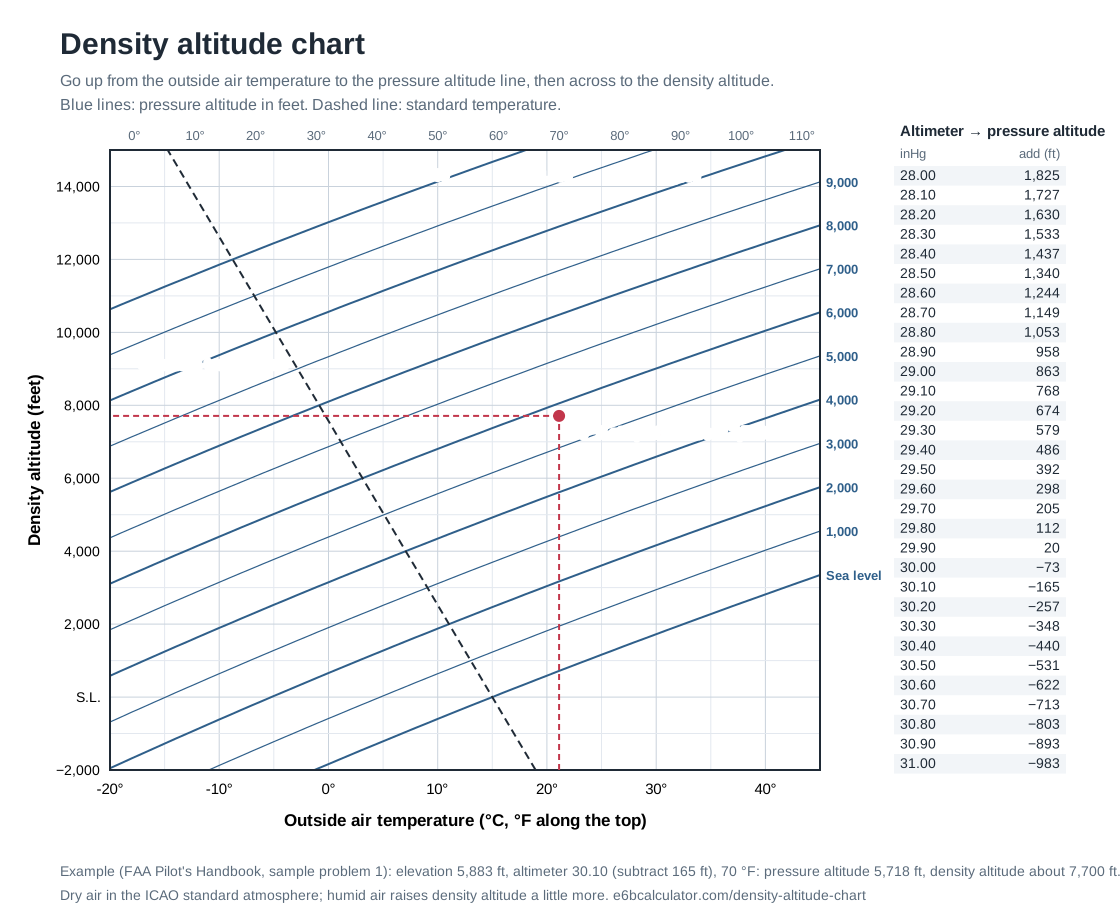
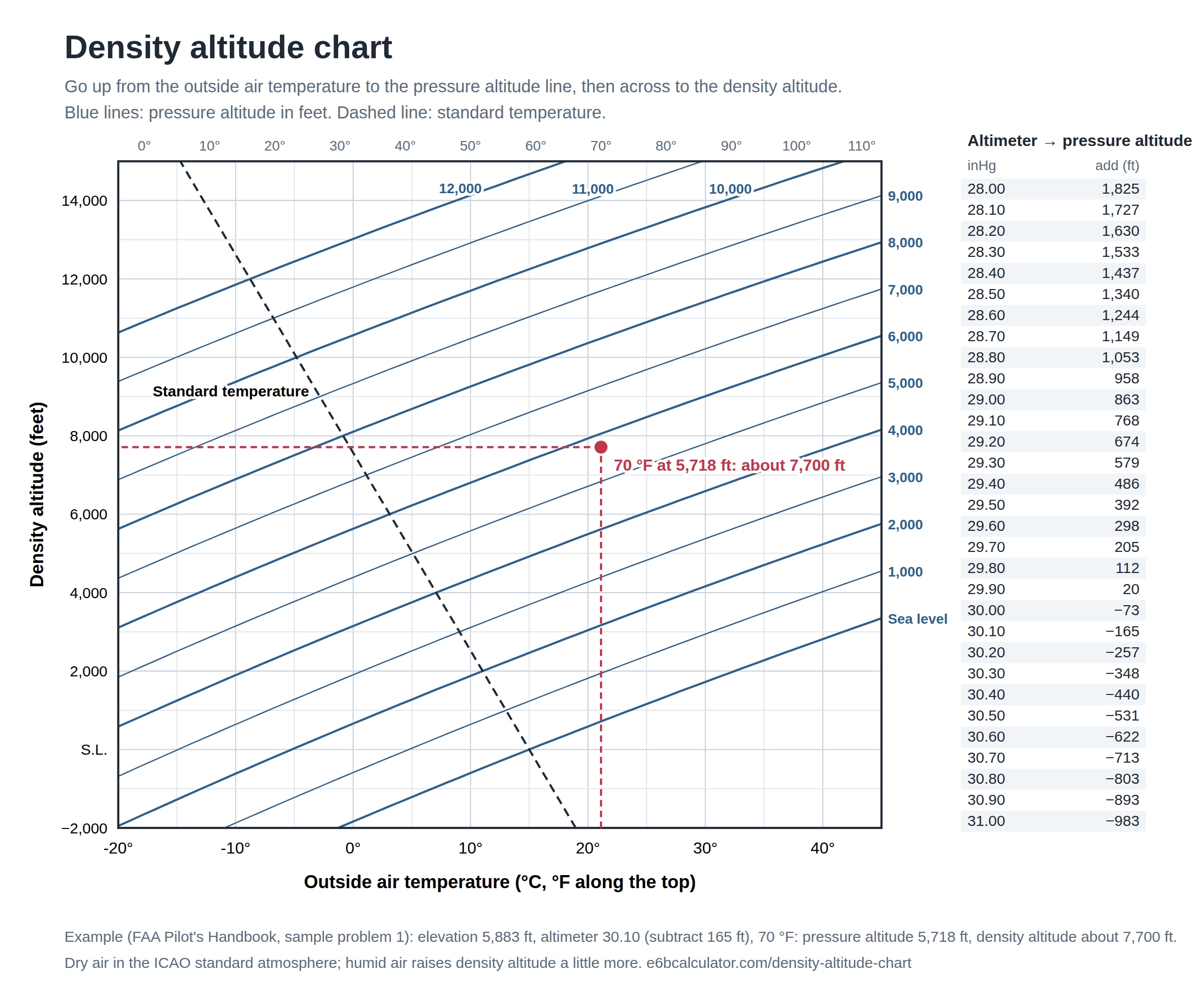
Density altitude is the altitude in the standard atmosphere where the air is as dense as the air around you. The chart draws it for every combination of pressure altitude (the blue lines, sea level to 12,000 feet) and outside air temperature (the bottom scale in °C, °F along the top): go up from the temperature to your pressure altitude line, then across to read the density altitude. The dashed line is standard temperature, where density altitude equals pressure altitude.
The example follows the FAA Pilot's Handbook of Aeronautical Knowledge's sample problem 1: field elevation 5,883 feet, temperature 70 °F and altimeter 30.10 inches. The table says to subtract 165 feet, so the pressure altitude is 5,718 feet, and going up from 70 °F to that line and across gives about 7,700 feet. The density altitude calculator gives the exact figure and can add humidity from the dewpoint.
The altimeter table
The table beside the chart turns an altimeter setting into the feet to add to the field elevation for pressure altitude: settings below 29.92 add height, settings above it subtract. Every value comes from the standard atmosphere's pressure formula, the same one the pressure altitude calculator uses; across the 30 settings the Pilot's Handbook lists from 28.0 to 30.8 inches, the two agree within one foot. The common shortcut, 1,000 feet per inch of mercury, is close near 29.92 but drifts by up to about 100 feet at the ends of the table (it gives 1,920 feet for 28.00 inches, where the table says 1,824).
Where density altitude bites
High fields on hot afternoons are the classic case: at a pressure altitude of 5,000 feet and 30 °C the density altitude is about 7,800 feet, so the airplane performs as if it were nearly 3,000 feet higher, and humid air adds a few hundred feet more. Takeoff distance grows, the climb rate shrinks and a non-turbocharged engine makes less power. Read the airplane's own performance charts with that density altitude, or with the pressure altitude and temperature they ask for, and plan the departure for the cool of the morning when you can.
Print it
The chart is a white landscape sheet that prints on letter or A4 paper: the PDF prints for a kneeboard or a lesson, the SVG scales without blurring, and the PNG fits a slide. The table below the chart gives the same values in numbers.
How to read the density altitude chart
- Find the altimeter setting in the table and add its conversion to the field elevation: 30.10 inHg means subtract 165 feet, so a 5,883-foot field is at a pressure altitude of 5,718 feet.
- Go up from the outside air temperature on the bottom scale, 70 °F (21 °C), to the line for that pressure altitude, about two thirds of the way from the 5,000 to the 6,000-foot line.
- From that point, go straight across to the left scale and read the density altitude: about 7,700 feet.
Questions pilots ask
How do you read a density altitude chart?
Turn the field elevation into pressure altitude with the altimeter table, go up from the temperature to that pressure altitude line, then across to the density altitude. The FAA Pilot's Handbook example, a 5,883-foot field at 70 °F with 30.10 inHg, gives a pressure altitude of 5,718 feet and a density altitude of about 7,700 feet.
What is the standard temperature line?
It joins the temperatures of the standard atmosphere, 15 °C at sea level falling about 2 °C per 1,000 feet. On that line density altitude equals pressure altitude; to the right, hotter than standard, density altitude is higher.
What is the rule of thumb for density altitude?
Add about 120 feet to the pressure altitude for every degree Celsius above standard temperature. It is close to the chart in everyday conditions; the chart and the density altitude calculator use the full standard-atmosphere formula.
Does humidity change density altitude?
Yes, a little: humid air is less dense than dry air at the same pressure and temperature, so it raises density altitude, by a few hundred feet on a hot, humid day. The chart is for dry air; the density altitude calculator adds the dewpoint.
Why does density altitude matter?
Airplane performance follows air density. A high density altitude means a longer takeoff roll, a lower climb rate and less engine power, so performance charts start from density altitude or from pressure altitude and temperature together.